Barcelona have played Atlético Madrid four times in just over three months. They have won two of those games, lost one, and drawn one on aggregate in a Copa semi-final they went out of. The fifth meeting, Tuesday at the Metropolitano, is the one that matters most — and it arrives with Barcelona in the worst position of any of the four preceding fixtures. Two goals down. No Raphinha. No Cubarsí. Away from home. Against a side that has not lost a Champions League knockout tie at the Metropolitano in six years.
Goals from Julián Álvarez and Alexander Sørloth have put Diego Simeone's side in a great position to knock Barça out. And Atléti, with a bigger squad and more focus on the Champions League, can compete with the right players at the right time — they rotated the entire starting XI for their Sevilla loss at the weekend, deliberately conserving legs for this one. By the time Sørloth retires, Barcelona will be right up there as one of his favourite victims. A gift that keeps giving. The Blaugrana turned him into somewhat of a superstar substitute.
I'm not going to pretend I think the comeback is likely. I thought weeks ago — even before the Newcastle tie — that Atlético were going to advance to the UCL final and lose it, and I still think that's the most likely scenario given how the first legs have gone (more on this later). I always felt Robert Lewandowski could make or break Barcelona's Champions League hopes at the start of the season and so far he's been a no show for the majority of this campaign.
That said, Barça played better than Atlético last week, even with ten men, and it's a testament to Flick's side that we still feel we have a 25–30% chance — a chance to come back from two goals down, without Raphinha and Cubarsí, away from home.
The Midfield Problem That Did Not Go Away
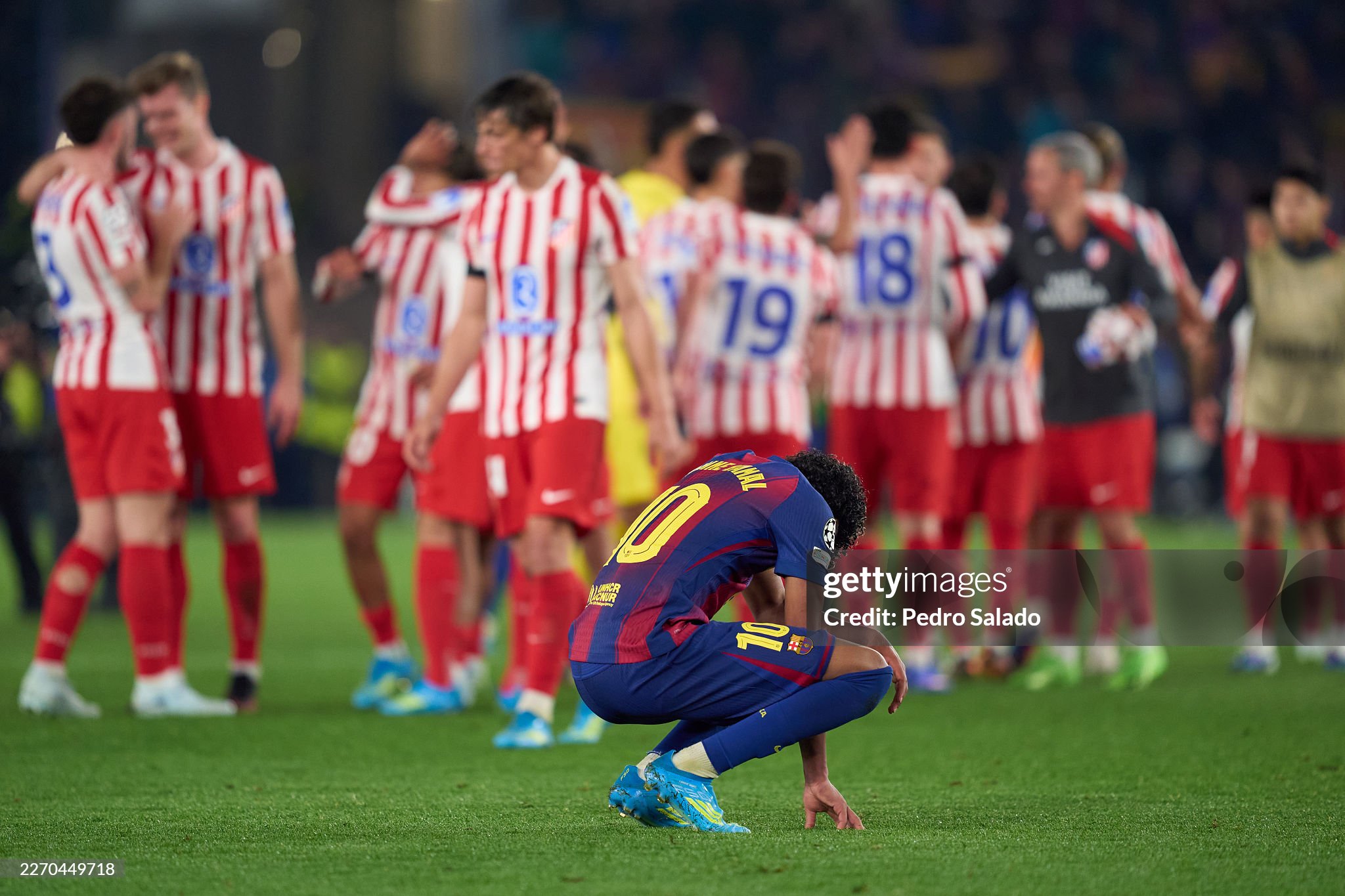
Barça played a very good first half at Camp Nou. They used the ball well, pressed high, matched Atlético's intensity. Rashford was the Blaugrana's biggest threat and should have scored inside ten minutes if not for Juan Musso. The first forty minutes went well. Then, in the span of two minutes, the tie broke: Cubarsí's last-man trip on Giuliano Simeone, a red card VAR could plausibly have downgraded to yellow, and Álvarez curling the resulting free-kick into the top corner.
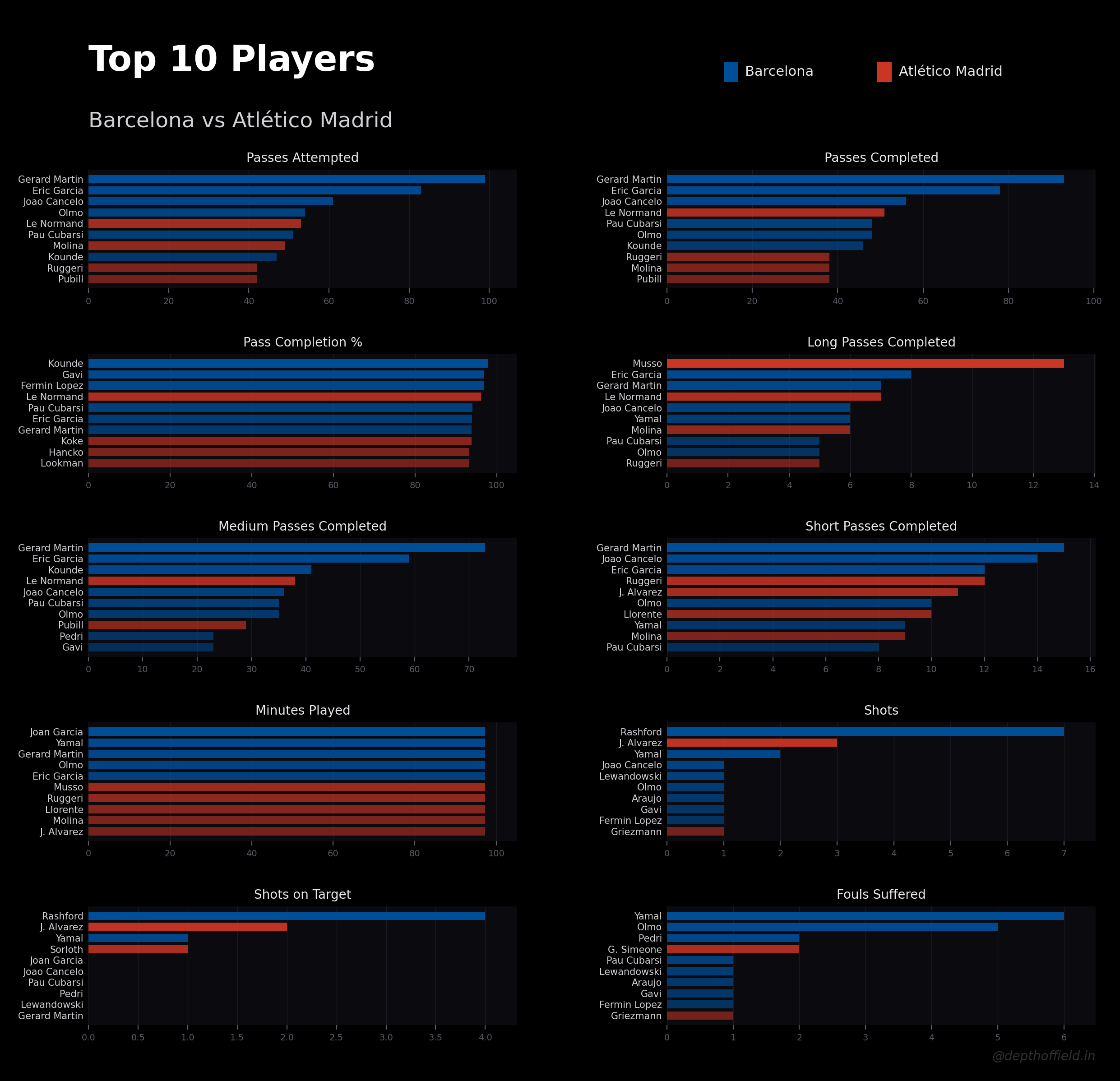
It's difficult to pinpoint exactly what was wrong in Barça's midfield at Camp Nou, but whatever Pedri and co. were trying, it just wasn't working. Dani Olmo remains something of an enigma for the club — immense one week, anonymous the next. Against Atleti, Olmo rarely offered anything as a supplementary attacking threat, even if his pass completion was amongst the best on show. He didn't really dovetail with Eric García and Pedri, and that lack of cohesion arguably denied Barça the control they needed against a Rojiblanco side that were more than happy to bypass that area of the pitch when given the chance.
This matters in a second-leg context for a specific reason. When Barcelona were reduced to ten men, they did not lose the game because they stopped creating. They lost because they could not sustain the kind of patient, suffocating build-up that breaks down a low block. That is midfield work. Pedri was hooked at half-time. Gavi and Fermín López gave the team more energy in the second half but not more control. At the Metropolitano, with eleven men and a fit Raphinha, that midfield problem might be recoverable. They will have neither.
Álvarez is the tournament's most form-heavy forward, and Atlético's signing of him is looking more and more like the decision that takes them deeper into this competition than any side they have put together in a decade. What is worth noting is that he did it from five touches in the Barcelona box across the entire first leg. Álvarez does not need possession. He needs a half-chance.
Rashford will be Pivotal
Marcus Rashford did everything at Camp Nou except score, and remains an acquired taste for many Culers. Tireless running, clever movement, associative play — he was the most consistent attacking threat Barcelona had across ninety minutes. He still finished the night on the losing side of a two-goal deficit, which some Culers will use as confirmation that the signing is working and others will use as confirmation that it isn't.
Both readings miss the point. Rashford is not in this team to be compared to Raphinha. He is in this team because Raphinha is injured, and will be again, and because Barcelona's attacking profile across eighteen months has increasingly looked like one elite wide forward flanked by players trying not to be him. If Rashford is judged on what he is actually doing — tireless pressing, quality service, end product that is growing — the only honest conclusion is that he earns his place next season.
What he cannot do on his own is solve Barcelona's deepest attacking structural problem, which is that the team is now playing as if the Number 9 does not exist. Against Atléti, Lewandowski did not receive a single meaningful chance-converting pass. He was not set up once. For a Polish striker still capable of finishing at an elite level, being starved like this is tactical negligence, and it has become a pattern rather than an anomaly.
The Red Card Problem
There have been vital red cards in crucial Barcelona fixtures throughout every key stage seemingly, but it would be wrong to frame this as a Flick problem. Barcelona were in a near-identical situation in April 2024, when Ronald Araújo was sent off in the twenty-ninth minute against PSG and Barcelona lost a game they were winning. Xavi was the manager. This issue is older than Flick.
What is a Flick problem — or at least a Flick choice — is the defensive line Barcelona continue to play. The high line is central to the identity of this team. It is also the thing that invites the specific mistake that keeps costing them: a last-ditch trip by the last defender when a runner gets in behind. This was the case against Cubarsí's red at Camp Nou and Araujo's at the Parc des Princes in 2024. I still don't understand why they wouldn't take the 1 goal deficit and attempt to outscore the opponent oor at least finish the game with 11 player on field. The entire structural bet of Barcelona's high line is that the team will win the ball back before the opposition runner gets onto a through-ball, because if they don't, the only thing between that runner and goal is a centre-back with nothing left to do. Flick has not yet had the defensive profiles — pace specifically — to make this system reliably safe.
That streak snapping matters less as a historical fact than as a confidence marker. The Camp Nou aura against Atlético has been broken. The follow-up is a trip to a stadium where the reverse has been true for Barcelona — a place they have won at just twice in the Simeone era, and never in a Champions League knockout.
Keep an Eye Out For
Barcelona historically don't do well when parking the bus. Their players are used to dominating games and having the ball, which is why accepting a 1–0 home defeat was never the right answer to the first leg, even in hindsight. They were always going to push.
There is a case for making Gavi the captain — for this leg specifically. He brings the kind of sustained intensity that Raphinha usually provides, the refusal to let the game drift is what Barcelona will need in the opening twenty minutes at the Metropolitano. It is a small, symbolic call that might not matter. It is also the kind of call Flick should be willing to make.
None of this means the comeback cannot happen. Barcelona have the individual talent to score three at any venue on any night, and Atlético's away form in this competition has been the one genuine weakness of their run — one win in five European away games. But the comeback is not being asked of Barcelona in the abstract. It is being asked of a Barcelona missing their best winger, their best young centre-back, and with a manager who still hasn't solved the structural tension between his defensive line and his attacking ambition.
Prediction: Atlético Madrid 2-1 Barcelona.
My read is that Atléti advance and hold on for something close to a 1–1 draw or a 2–1 win on the night. I will be rooting very hard to be wrong. At the same time, a 4–1 Barcelona win that takes the tie to penalties would instantly become one of the great nights in the competition's history.
Barcelona face Atlético Madrid for the 5th time this season. They'll have to overturn a 2-0 deficit to progress to the semi-final of the Champions League.